Lissewege, Ter Doest and the polders
Long before there was a port, this was the land of Lissewege, one of the oldest villages in the coastal region.
- Sheep on the salt marshes: Lissewege was probably first settled in the 10th century, when large flocks of sheep grazed the salt marshes; it was first mentioned in 1027 as Lissewega.
- A large parish: the parish of Lissewege once also included today's Zeebrugge, Heist and Knokke.
- The abbey of Ter Doest: the Cistercians of the abbey of Ter Doest reclaimed land from the sea and around 1275 built a large abbey barn that still stands; the abbey itself was destroyed by the Beggars in 1571.
- Pilgrims to Compostela: in the heyday of Bruges Lissewege was prosperous; the Church of Our Lady of the Visitation was a place of pilgrimage and the Sint-Jakobshuis gave shelter to pilgrims on the way to Santiago de Compostela.
- The miraculous statue: the church's statue of Mary was destroyed by the Beggars in 1586 and replaced by a statue from 1624, which is still carried in procession every year on the first Sunday in May.
A port in the sea: Bruges-on-sea
At the end of the 19th century Bruges wanted a direct connection with the sea again, and for this a port was built right out in the sea.
- The plan (1877): engineer August de Maere argued in 1877 for a direct link between Bruges and the sea, and King Leopold II was a strong supporter of a new sea port.
- The law (1895): after an agreement in 1894 between the State, the city of Bruges and the entrepreneurs Coiseau and Cousin, the project was fixed by law in 1895: an outer port on the coast, a sea canal and an inner port in Bruges.
- Bruges-on-sea: the outer port was named Zeebrugge, Bruges-on-sea; the name was first recorded in 1899.
- The Leopold II mole (1907): the port officially opened in 1907; the harbour mole of about two kilometres, built with the giant crane Titan, carried a railway to the ferries for England.
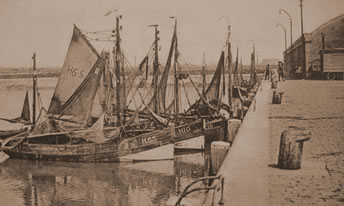
- Fishermen and bathers: the fishing port moved from Heist to Zeebrugge, and in 1914 the imposing Palace Hotel rose in the beach district.
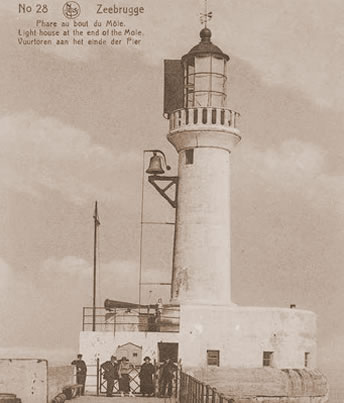
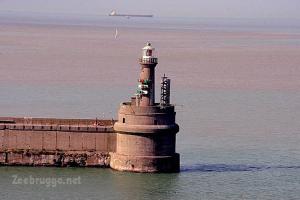
- The lighthouse: at the end of the mole stands the Zeebrugge lighthouse, with a red sector that guides ships.
The Zeebrugge Raid of 1918
In the First World War the young port became a German naval base and the target of one of the most famous raids of the war.
- A German base (1914): on 14 October 1914 the Germans occupied the port and turned it into a base for their submarines.
- Saint George (1918): on the night of 22 to 23 April 1918, Saint George's Day, the Royal Navy under Admiral Roger Keyes attacked the port with 168 ships and 1,800 men to block the harbour entrance.
- The Vindictive: the cruiser HMS Vindictive and the ferries Daffodil and Iris II attacked the mole, while old ships were scuttled in the channel.
- Destroyed: Zeebrugge was liberated in October 1918, but the port lay in ruins and had to be rebuilt.
Second World War and world port
After a second destruction, Zeebrugge grew in the second half of the 20th century into one of the most important ports in Europe.
- Blown up again (1944): in the Second World War the Germans occupied the port again and blew up the port installations as they retreated at the end of 1944.
- Liberated (1944): on 9 September 1944 the Allies took the port up to the sea locks, but the village of Zeebrugge was only liberated on 3 November 1944; the port was not fully restored until 1951.
- Part of Bruges (1971): since 1971 Lissewege, and with it Zeebrugge, has been part of the city of Bruges.
- Built in the sea: from the 1970s and 1980s the port was extended far out to sea, so that the old lighthouses of Heist lost their function.
- The Herald disaster (1987): on 6 March 1987 the ferry Herald of Free Enterprise capsized just after leaving Zeebrugge, and 193 people lost their lives.
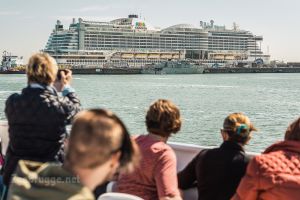
- A world port: Zeebrugge became the world's leading port for new cars and since 2022 has formed a single port company with Antwerp; on a harbour tour you can see the port up close.